This guest article was written by two recent college graduates – Hugh Hentschel and Julian Wu – of Middlebury College, a Division III school in Vermont. I hope this piece will open your eyes to the incredible experiences DIII college tennis can offer!
When people think of DIII tennis, they assume it’s low-level competition because it doesn’t have the visibility or aura that D1 programs carry. They hear “no athletic scholarships” and picture a low-stakes environment with a version of competitive tennis where nothing’s really on the line. What they don’t see is a roster full of guys who were nationally ranked juniors, who could’ve played D1 somewhere but chose academics over a scholarship, but still trained with the work ethic that got them there. The talent gap between D1 and D3 isn’t as wide as people assume, and a top D3 lineup could easily upset D1 mid-majors. The level is real. The spotlight just hasn’t caught up to it yet.
Off-Season Training
What most people don’t realize about DIII tennis is that it doesn’t really have an off-season—at least not the high-level programs. Players compete during the fall and spring seasons and train rigorously during the winter and summer to stay fit. To paint a picture of what the off-season looks like: we train on court for 2 hours, 6 days a week, with Friday and Saturday reserved for doubles and singles matches. 2 of the days of the week, we will typically do cardio training, whether it is on the track or the assault bike, and typically guys will lift at least twice a week in the gym on their own. And that’s every week.
Now, for every program, this schedule may look very different; most DIII programs in colder climates may not be able to play as much because they lack the facilities to do so. Take schools with track courts, for instance; the track team may need to use them during “regular hours,” so the tennis team may need to practice from 6-8 am on Monday and then 9-11 pm on Tuesday. That’s brutal. In extreme cases, players may need to pay for indoor courts themselves at a tennis club 30 minutes away during the off-season just to get a practice in. In DIII tennis, facilities are everything, in our opinion.
Additionally, DI teams can have full-time coaches, whereas in DIII, coaches aren’t allowed on the court with their players at all. While this is tough, as coaches can’t lead practices and be in closer contact with their players, it allows for great leadership opportunities as players can lead team practices and help each other improve. Organizing team practices and fitness sessions isn’t always easy, especially since no one wants to wake up for a 6 am practice, but I think going through that struggle and figuring it out together as a team can ultimately bring teammates closer.
The Season Itself
To shed some light on the DIII season, it’s important to point out its later start. This past year, DI teams began as early as January 16th, whereas DIII teams, on average, started in February, resulting in a shorter season. As referenced in an earlier post, the NESCAC has never been able to play the National Indoor Championships due to their later season start date, giving conferences like the UAA, SCIAC, and NCAC an advantage in getting more ranking points under their belt, which ultimately determines who can make it into the NCAA tournament.
Another distinct feature of DIII, especially in the Northeast, is the unorthodox indoor court surfaces you play on. Many DIII teams may not be able to afford top facilities like some DI teams, so they have to use their indoor track to play their matches (Bucknell has this too, lmao). Track is a very weird surface to adapt to, and surprisingly, track can play so differently depending on the condition it’s in; on some track, the ball skids and plays like lightning, and on other track, the ball can bounce up to 8 feet on an average kick serve. Constantly figuring out how to play on these funky indoor surfaces is a big challenge in DIII tennis, and it honestly serves as an equalizer if the team you’re playing on the road is far weaker (Bates comes to mind). Competing in DIII tennis can really force you to become a more resilient tennis player.
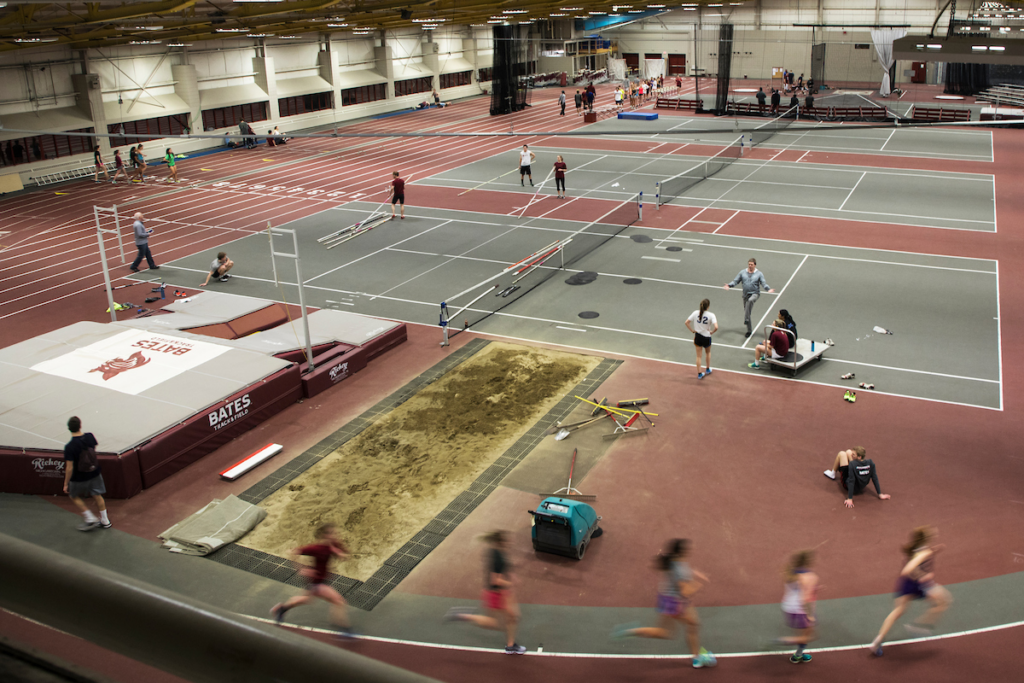
Bates Indoor Track Tennis Courts in Merrill Gymnasium, Lewiston, ME

Funny Instagram comment section about the Bates Indoor Courts
One aspect of the DIII season that flies under the radar is the travel and the ability to finish one’s match. In DIII tennis, travel is much easier, as most of it is done by Minivan/bus rather than by plane, which many DI athletes take. This makes travel less mentally and physically taxing and, again, allows DIII athletes to grind more for school. Another factor in DIII tennis is that, even in the regular season, everyone is allowed to finish their own match. Even if the match is clinched, everyone can still finish, which we think is the “right” thing to do. After all, people try to get recruited to a tennis team so they can actually compete to win. Additionally, the ability for players to finish matches has an enormous impact on players’ ability to make individuals for their team at the end of the year; we can’t tell you how many stories we’ve heard from DI where an opponent is on the verge of winning, but the match gets clinched, and that player is unable to gain the individual ranking points due to events out of their control. This is one aspect that people really overlook in DIII tennis.
The Money Question
When comparing DIII programs to DI powerhouses, it quickly becomes obvious that the budgets aren’t even in the same conversation. The difference shows up in athletic facilities, travel budgets, support staff, and more. At many DIII programs, you’re having to pay out of pocket for your uniforms and racquet stringing. Travel isn’t much easier either. Many teams have to cram their players and gear into vans and drive for hours to an away match because a bus was never within the budget. Another major travel constraint is that the NCAA groups programs by region rather than strictly ranking them for the NCAA tournament. This means that instead of getting the #1 vs #16 or the #8 vs #9 team in the country facing off in the NCAA round of 16, teams are paired by their geographic proximity to limit travel costs.
But less money doesn’t mean less effort. If anything, it means we DIII players are trying to make the most of every opportunity put in front of us. For example, when teams don’t have the budget or schedule for another official match, they find ways for their guys outside the lineup to improve through exhibition matches against teams (ex., both teams’ 10th-best guys may play a match against each other during the dual match itself). They’re not official, but it’s real competition, and players and coaches try to take advantage of these opportunities to improve their programs. That’s the real difference between a DI and a DIII program—it’s not about who works harder, but about working with what you have, and DIII programs have learned to make every dollar, every match, and every rep count.
On the Road
Being on the road together made for some of our best memories as student-athletes. Even when we had to deal with a tight budget like $15 meals (Chipotle for the 3rd time in a weekend), none of it ever felt like a burden. We had it easy compared to other teams, too, since we knew some teams had players share hotel beds to cut costs. Looking back, road trips are really where teams bond. Yes, the tennis matters. That’s the whole reason we’re out there. But what we’ll cherish the most isn’t a scoreline. It’s the long drives, cramped hotel rooms, and countless inside jokes that made every away match way more fun than it had any right to be.
Sometimes the constraint wasn’t money, but time. Take Tufts, for example: This past year — with a limited number of days the NESCAC conference allows and a deep enough roster to be heavy favorites against most teams — Tufts scheduled two matches at the same time and split their roster up to compete on the road against Brandeis and at home against Hamilton. This is definitely a sacrifice for a loud, rowdy team like Tufts, since they can’t have their full squad together to cheer each other when half the team is playing at another school. It’s definitely not an ideal way to draw up your schedule, but if you’re a program trying to maximize opportunities for players on a tight calendar, these are the sacrifices you have to be willing to take.

Tufts scheduled two matches at the same time this past year
Academic/Athletic Balance
As mentioned before, many tennis players in DIII forgo opportunities in DI to achieve a better academic balance (or simply because they want to play more of their years). I personally know someone who gave up the opportunity to play for Penn to play for WashU. There have been plenty of kids who do not pass the pre-read bar at NESCACs and can easily get into Ivy League schools. From talking to plenty of kids over the years, we can safely say it’s easier for the Ivies to maneuver in athletes with poor GPAs than it is for academically rigorous DIII schools.
From our own experience, academic balance can be a real challenge while balancing athletics and training consistently 20+ hours a week. For starters, many clubs and office hours take place during regular training hours. This can make receiving extra help difficult, but not impossible, as it forces us to coordinate our rigorous academic schedules with athletics and take on that responsibility ourselves. But the great thing about being on a team is having teammates to take classes and study with, who can really help push you through the late nights when you feel both physically and mentally tired. At a Power 5 DI school, where academics are more in the background and coaches make you skip classes for practice, you really miss out on these late nights with teammates, which, again, we really think can help cultivate good team culture.
Why It’s Worth It
Given all of the differences that may seem like setbacks in Division III compared to other athletic divisions, DIII tennis offers something that a lot of recruits don’t factor in. If you’re stuck deciding between a mid-tier DI or DII program and a top DIII program, going DIII will give you the consistent opportunity to compete for a national title. Competing in the NCAA tournament and making a deep run to the Final Four is something that only a few student-athletes will ever experience. Those are the special kinds of memories that stick with you for a lifetime and make you feel like choosing to go DIII was the right decision all along.
Yet, the culture around these experiences is different too. DIII athletics is built around the idea of “student first, athlete second,” and that theme shows up in ways that impact your college experience. You can take on challenging internships, study abroad, and simply enjoy downtime with your best friends without worrying about being in the tennis facility for 6+ hours a day.
And somehow, none of that flexibility ever feels like it comes at the team’s expense. DIII tennis gives you the best of athletics, academics, and social life all together. Recruits don’t realize this is possible until they are truly living it. That’s the real case for DIII. Not a fallback, not a compromise, but a genuinely different way of getting everything college tennis has to offer.
ABOUT THE AUTHORS
Julian Wu 
Julian Wu ‘26 is a former Division III collegiate tennis player at Middlebury College and co-founder of The 3rd Set, a blog dedicated to telling the stories, analyzing the trends, and highlighting the people that make Division III tennis unique. A lifelong tennis player and current coach, Julian is passionate about sharing the D3 experience and helping players and families better understand the college tennis landscape.
Hugh Hentschel
Originally from Rye, NY, Hugh Hentschel ‘26 is a former Division III men’s tennis for the Middlebury College Panthers and is a co-founder of The 3rd Set Blog. Hugh was an All-American in Doubles at Middlebury college and primarily played lines 5 and 6 throughout this college career. Hugh is passionate abut promoting DIII tennis and opening up people eyes about an amazing opportunity they may be wildly overlooking.















Comments